Seeds of Strength: Hope and Inspiration from the Complementary Pathway for Refugees

Seeds of Strength: Hope and Inspiration from the Complementary Pathway for Refugees

My name is Asadullah. I was born a Rohingya in Myanmar. Because of persecution, my family fled to Bangladesh when I was a child. It was an unexpected, painful journey. But we had no choice.

My father, an Islamic scholar, believed education was our only weapon. Even though we were denied schools, he made sure we studied at home later though the British Council. In Chittagong, I built a life. I worked as an accountant, got married, and tried to live normally.

But being Rohingnya in Bangladesh meant living in hiding. As laws grew stricter, the fear became unbearable. Every day we feared the risk of being found out. If the authorities discovered our identity, we could be forced into the camps, where life was unimaginably hard. One day, I realized we had no future there.

I moved to Indonesia, where some relatives had already settled. For the first time, I felt kindness and compassion, I was not hated for who I was. But there were new struggles. Refugees in Indonesia cannot work legally, open bank accounts, or access basic services. Language barriers made daily life harder.

Once again, our lives were restricted by rules we did not choose.

Still, I refused to give up. I became an interpreter for NGOs and UNHCR, and my wife worked with IOM.

We helped bridge communication gaps, giving our community a voice. It gave us purpose and dignity.

Then I discovered something new, labor mobility pathways. Unlike traditional refugee resettlement, labor mobility allows skilled refugees to migrate to another country for work, based on their qualifications and experience. It’s a solution that recognizes refugees not just as people in need, but as professionals with potential. For many of us, it’s a chance to rebuild our lives with dignity.

I believed my background could open a door. I applied for jobs across the world, attending over a hundred interviews. Finally, a Canadian employer said yes. It was me fighting for my future, using my skills, persistence, and hope. With support from TalentLift, IOM, UNHCR, and the Indonesian Immigration Office, I applied for permanent residency in Canada. I am now waiting for visa approval and preparing to begin a new chapter.

But my journey is not only for me. I speak to other Rohingya, encouraging those who speak English to teach others. I organize sessions on labor mobility and remind my community: You have potential. You have dignity. You have a future. We must lift each other up.

My dream is simple, to live in peace, respected like any other human being. My biggest hope is to become strong enough to support my community, especially those still stuck in limbo.
More than anything, I want refugees to be seen not for our past, but for our potential.

We are not just victims.

We are survivors.

We are ready to build.

We are ready to contribute to a more peaceful world.

Ali’s Journey: Reconnecting with Art through Animation

Ali’s Journey: Reconnecting with Art through Animation

Ali, a 26-year-old refugee from Afghanistan, has been living in Indonesia for the past decade. Back in his home country, Ali was a painter and owned an art gallery, a passion he had nurtured since childhood. His work had even garnered media attention, giving him a sense of pride and fulfillment. But after fleeing Afghanistan, Ali found himself in a new place, far from his family, and struggling with the uncertainties of life as a refugee. The artistic spark that once defined him seemed to dim as he searched for a way to reclaim that sense of purpose.

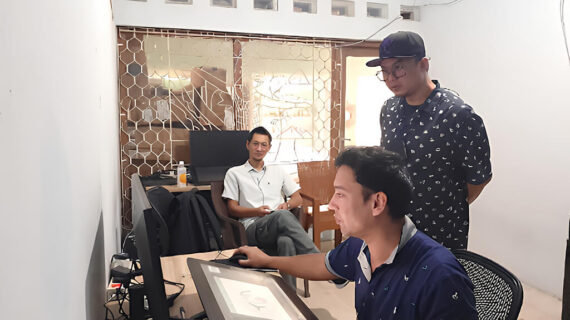
One day, Ali heard about an opportunity to participate in the “Animation for Humanity” project, a collaboration between CWS Indonesia and Japan. Although animation was different from the canvas work he was used to, Ali saw it as a chance to reconnect with his creative spirit. Eager to learn and adapt, he joined the project, ready to explore this new medium.

The transition wasn’t easy. Ali faced numerous challenges, starting with unfamiliar design tools. The digital aspect of animation was foreign to him, and it took time to adjust. Additionally, the journey to the workstation was long and tiring, sometimes taking up to three hours by public transportation. But despite these obstacles, Ali found joy in the process. The animation work offered more than just a source of income. It became a new way for him to channel his energy and focus on something positive.

Over three months, Ali honed his skills and began collaborating with Launch Box, a Japanese animation studio. Each completed animation cut brought a small sense of accomplishment, reminding him of the satisfaction he once felt as a painter. More importantly, the project helped him cope with the stress and anxiety of his uncertain future. “Mentally, they kept us busy, so we don’t have to think about the future or the past… we don’t have to stress all the time… in a positive way,” Ali reflected.

Looking ahead, Ali plans to continue exploring opportunities in the animation industry, staying connected with his passion for art. The “Animation for Humanity” project has given him a new outlet for his creativity and a renewed sense of purpose, helping him navigate the challenges of life as a refugee with resilience and hope.

The Story of Eni: a heart of compassion and resilient amid the raging floods

The Story of Eni: a heart of compassion and resilient amid the raging floods

Eni (50) is a committed housewife whose daily activities revolves around taking care of her home, children, and husband. Albeit her routine, she carries a deep sense of social responsibility and is always eager to contribute to her community activities. She is an active member of the Disaster-Preparedness Village Team (or KSB) in Katimbang Sub-district, formed by INANTA-YCWS through the CLEAR program, with the support of Makassar City Social Affairs Department.

As a part of disaster mitigation team, Eni holds a crucial role in delivering early weather warnings from the BKMG (Indonesian Meteorology, Climatology, and Geophysics Agency) to the community.  Once the BKMG issues an alert for extreme weather or a possibility of flooding, Eni, along with her team swiftly spread the information and provide instruction – ensuring residents are prepared. This is no easy task, as she must ensure that people understand what to do –whether safeguarding their valuable possessions or evacuating when necessary.

“As KSB member, I have to be on alert under any circumstances, which mean I need to take care of my health and immunity… since I am responsible for helping the flood-affected residents. We must prepare ourselves – especially our families and for our own well-being.” said Eni passionately when she told us about her experiences as KSB member.

When flood strikes, Katimbang Sub-district has several severely affected areas. The KSB team, including Eni, works tirelessly to evacuate residents living in those flood-prone zones.  Eni told us that some residents chose to stay in their homes despite worsening conditions, as long as they had enough basic necessities. However, for those who lacks essential supplies, Eni with her team personally delivered aids to their homes, even though her own house was also affected by the flood.

Evacuation process possess its own major challenges, according to Eni and her team. One of the most pressing issued was the lack of rubber boats. Katimbang Sub-district had only one rubber boat, while the majority of the Katimbang residents, especially in two particular areas (called the block AF and Kodam areas), desperately needed evacuation. With limited transportation, evacuations became even more difficult, as many people urgently sought safety.

Thankfully, with the support of the CLEAR program, the KSB team received additional equipment, including stretchers. While not ideal for flood conditions, these stretchers proved to be lifesaving tools. The team was able to use them effectively to safely carry immobile residents to evacuation centres or safer locations. This equipment played a significant role in improving evacuation efforts, particularly in locations where access was severely restricted by floodwaters.

“… when we evacuated, there was an elderly person who needed to be transferred to the hospital, but the rubber boat was still far from the area. So we improvised using the stretcher,” recalled Eni.

Eni’s sense of social responsibility and solidarity did not stop there. Beyond direct involvement in rescuing activities, Eni also helped in the community kitchen team, preparing meals and other essentials for displaced residents.

“… the KSB team does not just focus on one task – we try to handle everything. For example, during the first few days of flooding, there was yet received assistance from the government, so I took the initiative to help in the community kitchen. I packed the meal, delivered them to those in need”,

Despite her own home being flooded, she never hesitated to lend a hand. Living just 150 meters from the evacuation centre, she was always present, making sure the needs of the affected residents were met. Her selflessness and dedication are not just for her family, but also to her wider community. That made her a true example of a compassionate and courageous leader.

Fortunately, under the CLEAR program, the Katimbang KSB team is now better organised and more prepared to respond to future disasters. They no longer have to wait long to establish emergency posts and can carry out their task more efficiently – hence more lives can be saved.

Despite facing countless challenges, Eni never backs down. Her spirit of solidarity and service has earned her the respect and admiration from many.  She proves that courage, resilience, and the power of community can overcome even the toughest challenges – no matter how devastating the floodwaters may be.